
PAT Testing Course Cardiff

PAT Testing Course
Cardiff

  • 1-Day Course · 9:00–16:00
  • £195 + VAT

Our PAT Testing Course in Cardiff is a hands-on, one-day programme that shows you how to inspect and test portable electrical appliances safely, accurately and in line with current regulations.

Over the day you'll work through visual inspection, formal testing with a PAT instrument, recording results and understanding the IET Code of Practice (5th Edition), so you leave able to certify equipment with confidence.

It's ideal for facilities staff, maintenance teams, landlords, caretakers and anyone planning to launch their own testing service across Cardiff and the surrounding area, whether you'll use your own tester or check appliances on client premises.

You don't need any prior electrical training to take part, the course starts from the basics, while qualified electricians still gain plenty from the practical, instructor-led sessions.

Trustpilot
TrustScore 5.0  |  1,822 reviews
Read Skills Training Group reviews on Trustpilot
Learner using a PAT tester in class
Hands-on PAT testing practice
Group of learners on a PAT testing course
Learners testing electrical equipment
Learner carrying out a PAT test
Learners inspecting an appliance together
100% Money-Back Guarantee
If you don't pass your PAT testing course, we'll refund your booking in full.

Course highlights

  • Digital certificate provided
  • Industry recognised qualification
  • One-day course · 9:00–16:00
  • Over 1,822 5-star Trustpilot reviews
  • Content follows the IET COP 5th Edition
  • Trained by qualified industry experts
  • Clear, easy-to-follow content — no prior experience needed
  • Bulk discounts for group enrolments

What You'll Learn

A complete, practical grounding in PAT testing

This PAT Testing Course provides learners with a comprehensive understanding of:

  • Electrical safety and common electrical dangers
  • The role of portable appliance testing (PAT) in workplace safety
  • Visual inspections and identifying faults in electrical equipment
  • Equipment construction and earthing classification
  • How to conduct in-service inspection and testing
  • Using a PAT testing machine to run tests correctly
  • Earth continuity, insulation resistance, earth leakage and load tests
  • Understanding and recording test results
  • Responsibilities under electrical safety regulations
  • How to ensure electrical equipment remains safe for continued use

You'll gain hands-on experience using an actual PAT tester, helping you become a confident and competent PAT tester upon successful completion.

Training You Can Trust

Delivered by electrical safety professionals

This PAT testing training course is delivered by experienced electrical safety professionals and aligned with the IET Code of Practice for the inspection and testing of electrical equipment.

While PAT testing is a non-statutory requirement, it is recognised as an essential part of electrical safety management. This course ensures learners gain suitable knowledge, practical skills, and a thorough understanding of relevant legislation and responsibilities.

Upon completion, learners receive a training and competence certificate, demonstrating sufficient knowledge to carry out PAT testing confidently.

Experienced PAT testing instructor at Skills Training Group

Why Take This Course?

Protect people and prove compliance

Defective portable appliances remain a frequent cause of workplace fires and electric shocks, and this one-day Cardiff course equips you to:

  • Reduce workplace accidents caused by faulty appliances
  • Understand your legal responsibilities under UK health & safety law
  • Ensure compliance with HSE and insurance requirements
  • Improve awareness of safe electrical working practices
  • Protect yourself and colleagues through better risk control
  • Demonstrate competence and due diligence during audits

Completing this course supports a proactive health and safety culture in your workplace and strengthens your compliance with national safety regulations.

Course Content

Seven focused, hands-on modules

The training is divided into short, interactive modules:

01 Introduction to PAT Testing and Electrical Equipment

This opening module sets the foundation for everything that follows. You'll learn exactly what Portable Appliance Testing (PAT) is, why it matters, and where it fits within an organisation's wider electrical safety regime. We explain the key terminology used throughout the industry so that nothing later in the course feels unfamiliar.

You'll also be introduced to the different categories of electrical equipment you'll encounter as a PAT tester — including portable, movable, hand-held, stationary, fixed and IT equipment — and to the equipment classes (Class I, Class II and Class III) that determine how an appliance is protected against electric shock. Understanding these distinctions early is essential, because the class and type of an appliance dictate which tests are appropriate later on.

02 Electrical Safety, Electrical Dangers and Relevant Legislation

Before you pick up a tester, you need to understand the hazards you're working to control. This module explains how electricity causes harm — covering electric shock, burns and the very real risk of electrical fire — and the conditions that make faulty equipment dangerous.

It then sets out the legal framework that underpins PAT testing in the UK. You'll cover the Health and Safety at Work etc. Act 1974, the Electricity at Work Regulations 1989, the Provision and Use of Work Equipment Regulations 1998 (PUWER) and related duties. Importantly, we clarify a point that's widely misunderstood: while there is no specific law that says "you must PAT test", duty-holders are legally required to keep electrical equipment in a safe condition, and inspection and testing is the recognised way of demonstrating that. You'll come away knowing who carries that responsibility and what "reasonably practicable" really means in practice.

03 Visual Inspections and Equipment Construction

The visual inspection is the single most important part of the PAT process — it identifies the majority of faults before any meters are connected. In this module you'll learn how to carry out a thorough formal visual inspection and how to recognise the signs of damage, wear and misuse that warrant removing an appliance from service.

We go inside the equipment itself, covering correct plug wiring to BS 1363, appropriate fuse ratings, cable and flex condition, strain relief, and the integrity of the casing and connections. You'll also learn how an appliance's construction relates to its equipment class, and the difference between the everyday user checks staff should perform and the formal visual inspection conducted by a competent person.

04 Practical Instruction Using PAT Testing Equipment

This is where the course becomes truly hands-on. Working with real PAT testing instruments in the learning zone, you'll become comfortable setting up and operating the equipment safely and correctly. We cover the different types of tester you'll meet in the field — from simple pass/fail units to advanced downloadable instruments that store and transfer results.

You'll practise connecting appliances correctly, understand the importance of using calibrated equipment, and build the muscle memory and confidence that only come from repetition. By the end of the module, handling a PAT tester will feel second nature.

05 Inspection and Testing Procedures

Here you'll learn the formal test sequence and how to apply it to different appliances. The module walks through the core electrical tests — including earth continuity testing, insulation resistance testing, lead and polarity checks, and functional checks — and explains the purpose of each one and what it actually proves about an appliance.

Crucially, you'll learn how the correct sequence of tests differs between Class I and Class II equipment, so you always apply the right tests in the right order. We emphasise safe working practice throughout, ensuring that every test you carry out is both meaningful and safe.

06 Interpreting Test Results and Record Keeping

A test is only useful if you can interpret it correctly. This module teaches you how to read your results against acceptable limits, decide whether an appliance has genuinely passed or failed, and act appropriately on a fail. You'll learn correct labelling of tested equipment and how to maintain clear, defensible records.

We also cover how to determine sensible retest intervals. Following the risk-based approach adopted in the current edition of the IET Code of Practice — which moved away from rigid, fixed frequency tables — you'll learn to set inspection and testing frequencies according to the type of equipment, its environment, how often it's used and who uses it. Good record keeping and a well-maintained asset register are presented as the backbone of demonstrating ongoing compliance and due diligence.

07 Legal Requirements, Non-Statutory Requirements and the IET Code

The final module ties everything together and places your new skills firmly within their regulatory context. You'll learn the difference between statutory requirements (the law you must follow) and non-statutory guidance (recognised best practice that helps you comply), and why both matter to a competent PAT tester.

At the heart of this module is the IET Code of Practice for In-Service Inspection and Testing of Electrical Equipment, currently in its 5th edition. We explain what the Code says, how it supports the relevant legislation, and how to use it as your go-to reference. You'll finish the course understanding what "competence" means in this field, how to demonstrate due diligence, and how to carry out PAT testing to a professional, defensible standard.

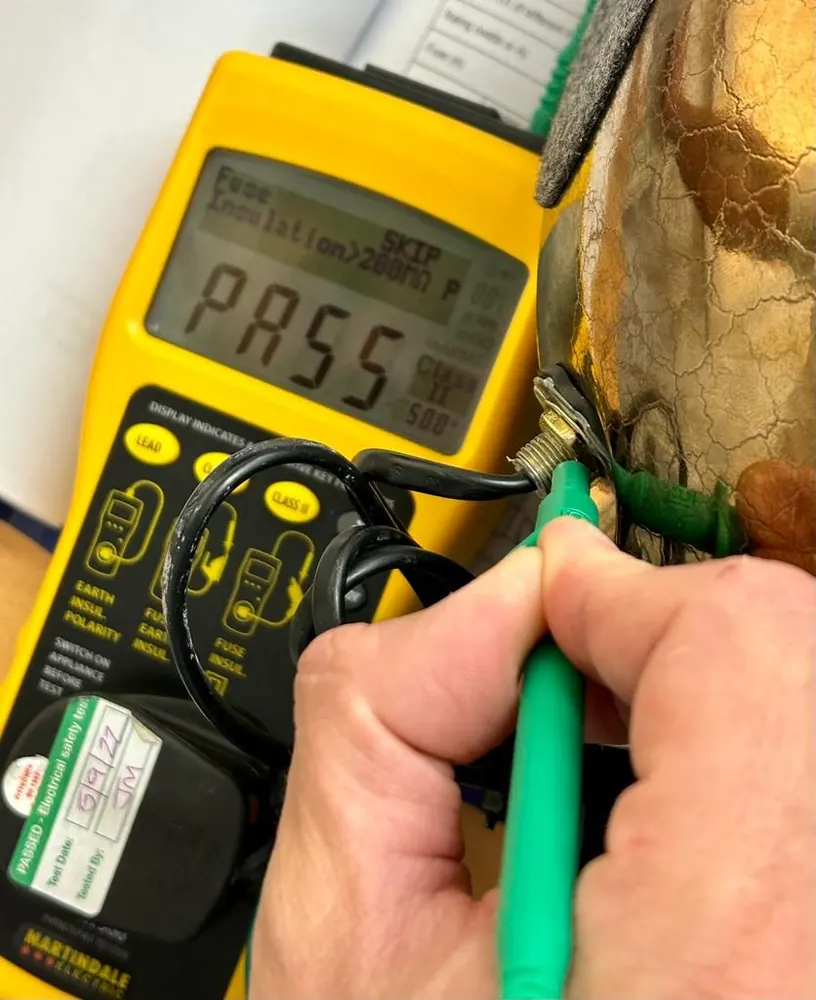
Learners spend significant time gaining hands-on experience in the learning zone using real testing equipment.

Assessment

Prove your competence with confidence

Assessment includes a practical assessment and a knowledge check to confirm competence.

Learners must demonstrate they can safely conduct PAT testing, understand test results, and apply the IET Code of Practice correctly.

100% money-back guarantee — we're confident you'll pass.

Your Skills Training Group competence certificate

On successful completion, you'll receive a training and competence certificate issued by Skills Training Group, confirming you can carry out portable appliance testing safely and correctly.

The certificate demonstrates that you've met the competence standard the HSE expects of anyone performing PAT testing under the Electricity at Work Regulations 1989, and that you can apply the IET Code of Practice (5th edition) — the recognised industry benchmark — in practice.

It confirms you can:

  • Safely conduct visual inspections and instrument testing on Class I and Class II appliances
  • Correctly interpret test results and make sound pass/fail decisions
  • Apply the IET Code of Practice and record results to a professional standard

This is the evidence of competence that employers, commercial clients, landlords and facilities managers ask to see before awarding work — and that insurers typically require before issuing public liability cover for PAT testing.

Certificate of Achievement
This is to certify that
Joe Bloggs
has successfully completed the
PAT Testing Course
Assessed to the IET Code of Practice for In-Service
Inspection & Testing of Electrical Equipment (5th Edition)
Derek Bruce
Operations Director
26 June 2026
Date of Issue

Suitable For

Who this course is for

This PAT Testing Course in Cardiff is well suited to:

  • Facilities and maintenance staff
  • Landlords and property managers
  • Office managers and duty holders
  • Tradespeople and contractors
  • Those starting a PAT testing business
  • Qualified electricians seeking refresher training
  • Anyone responsible for electrical equipment safety

No previous electrical experience is required.

In-house private training & group bookings

Training multiple staff? We can offer a group discount on one of our public courses, or hold a private training course at your workplace for a fixed rate.

Enquire about group training

Find Us

PAT Testing Training in Cardiff

Train with our experienced instructors at a welcoming venue in the Heath area of north Cardiff, just a short hop from the city centre.

Maes-y-Coed Community Centre
1 Jubilee Gardens, Heath, Cardiff
South Glamorgan, CF14 4PP
Free on-site parking available

Getting here

By bus: Cardiff Bus routes serving Heath and Birchgrove stop within a few minutes' walk of Jubilee Gardens, with regular services running up from the city centre along Caerphilly Road and Heathwood Road.

By train: Heath Halt (High Level and Low Level) is the closest station, only a short walk away, on the Rhymney and Coryton valley lines; from Cardiff Queen Street it's a quick few-minute journey, with Cardiff Central a short ride beyond that.

By car: The venue sits just off the A48 Eastern Avenue and the A470, roughly 10 minutes from Junction 32 (Coryton) of the M4, with free on-site parking available for everyone attending.

FAQ

Frequently asked questions

Do I need previous electrical experience?
No. The course is designed for complete beginners — no previous electrical experience is needed. Qualified electricians are also welcome and will benefit from the hands-on practical instruction.
Is PAT testing a legal requirement?
PAT testing itself is not a legal requirement, but UK health and safety law requires employers and duty holders to keep electrical equipment in a safe condition. PAT testing is a widely recognised way to demonstrate that duty of care.
Will I use a real PAT testing machine?
Yes. You will spend significant time in our learning zone gaining hands-on experience with real PAT testing machines and equipment.
Do I need to bring my own PAT tester?
No. We provide all the PAT testing equipment you need on the day of your course.
Can I use my own PAT tester?
Yes. If you'd like to train on the tester you'll use day-to-day, you're welcome to bring your own — just let us know in advance.
Is this suitable for starting a PAT testing business?
Absolutely. The course covers everything you need to test competently and confidently, making it ideal for anyone looking to start their own PAT testing business.
Do I receive a competence certificate?
Yes. On successful completion you'll receive a training and competence certificate confirming you are a competent PAT tester.
Who is the course certificated by?
The course content follows the IET Code of Practice (5th Edition) and you receive an industry-recognised certificate from Skills Training Group on completion.
Does the PAT Testing Course expire?
Your certificate has no fixed expiry, but we recommend refresher training every 3 years to stay current with best practice and any updates to the IET Code of Practice.

Why train with us?

  • Trusted by thousands of UK learners
  • Training that complies with industry requirements
  • Outstanding customer support
  • Experienced industry-expert trainers

We're highly rated

Skills Training GroupCareer & Education Provider
5.0
Based on 1,822 reviews
PAT Testing Course Cardiff £195 + VAT · 1-day course
Book Now